Cate Blanchett in ‘Don’t Look Up’

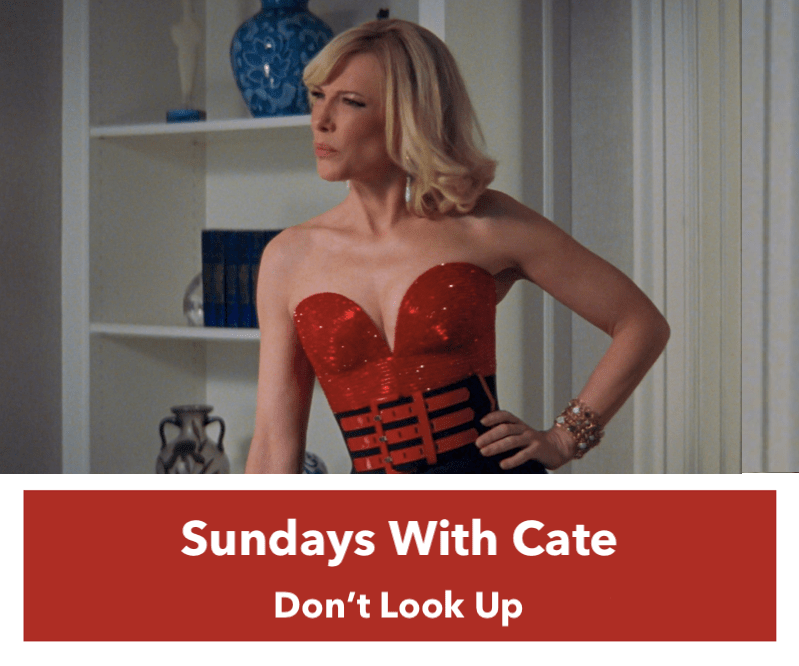
There’s a comet hurtling towards earth and a bunch of movie stars at trying to not look up at it. To discuss Cate Blanchett’s second movie this holiday season -Adam McKay’s climate change satire Don’t Look UpMurtada welcomes critic Boyd van Hoeij from The Film Verdict to the podcast.

Click to Listen:
Subscribe:  Apple Podcasts   /   Stitcher   /  Spotify  /   iHeart

What is the film about?

From IMDB: Two low-level astronomers must go on a giant media tour to warn mankind of an approaching comet that will destroy planet Earth.

Who does Cate play?

Bree Evante, a morning news show host determined to put a positive spin on news.

What year did it come out?

2021

Critical Response: Metacritic : 52     RT: 56

Topics Discussed:

  • General impression on Adam McKay and his films.
  • Don’t Look Up is being sold as a cross between Dr Strangelove and Network. Are the similies spot on?
  • The targets of the satire – incompetent governments, media, tech billionaires, populace believing in politics not science – are obvious. There’s a shorthand that makes each character’s real world avatar easy to get hence the laughs but does that undermine the film’s intelligence?
  • Huge cast – Leonardo DiCaprio, Meryl Streep, Jennifer Lawrence, Rob Morgan, Tyler Perry, Jonah Hill, Ariana Grande, Mark Rylance, Timothée Chalamet… and more? Who’s funny? Who’s annoying? Who’s unmemorable? Who brought the heart and pathos? Who stands out?
  • Leo’s big Peter Finch-like monologue. Does it work?
  • Cate’s look; called “yassified” by the NYTimes. Extreme fembot.
  • Cate and Leo – The Aviator reunion?
  • Cate and Meryl; they are in one scene together but hardly interact. So we fantasy cast them in other projects

Film within context of Cate’s career:

2021 is turning out to be a big year for Blanchett. She has this and Nightmare Alley coming out within days of each other. 

Cate Blanchett in Supporting Parts:

  • Cate came to prominence as a lead in Elizabeth (1998) but has since taken many supporting roles. Is there a link between them? In story? In collaborators?
  • Some of the supporting parts include The Man Who Cried (2000), The Shipping News (2001), Babel (2007), Hanna (2011).

Subscribe:  Apple Podcasts   /   Stitcher   /  Spotify  /   iHeart

Like? Rate and Review. Have a question? Leave us a comment.

Review: Being the Ricardos

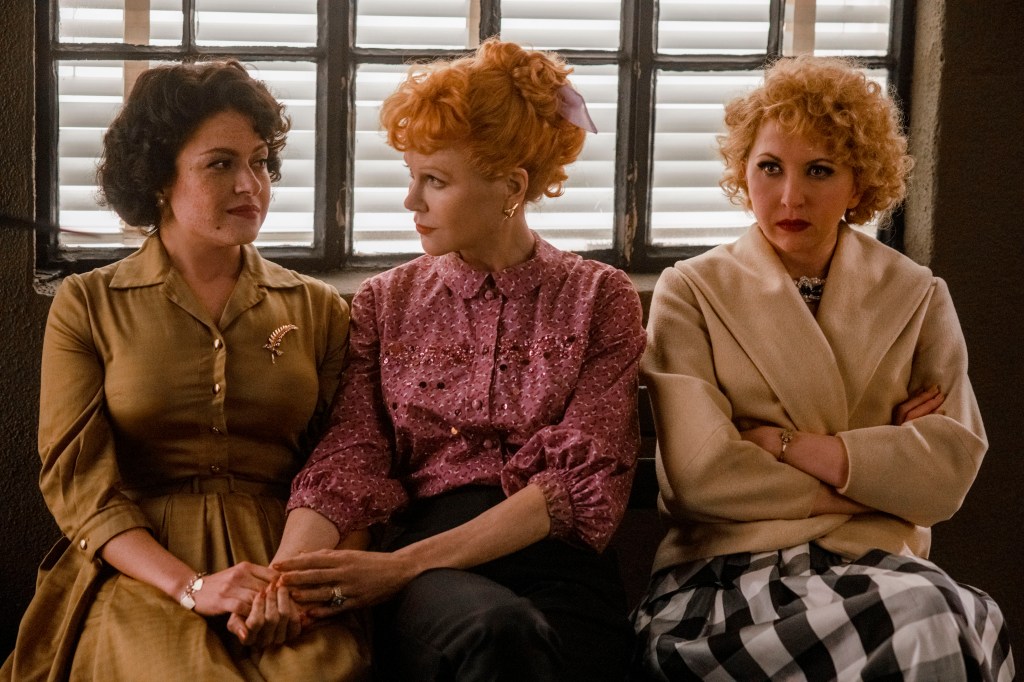
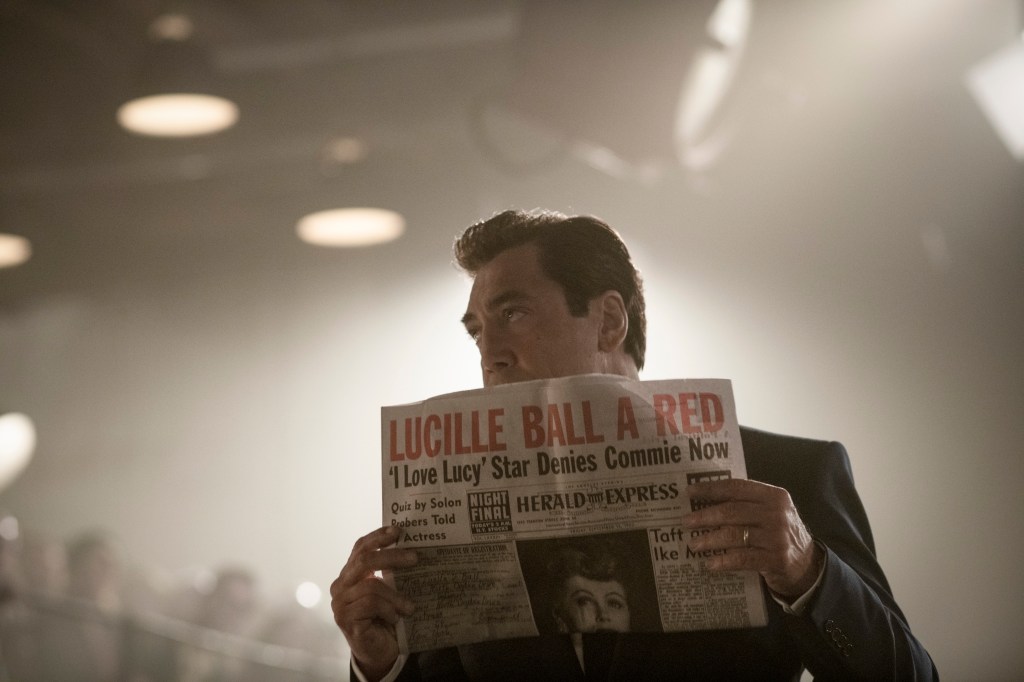
Early on in Being the Ricardos the cast and crew of I Love Lucy are assembled for a table read of an episode of the show. It’s sometime in 1952. Something is off, they can’t land the jokes. Is it the writing? The actors? The film takes a jump into Lucille Ball’s head. She starts to imagine the show alive. And with that she’s able to pinpoint what’s off and of course fix it. This must be a film about Ball’s creative process? Alas that was a brief interlude, though it’s repeated a couple more times, how Ball (Nicole Kidman) creates or how her show is conceived are not top of mind for writer/director Aaron Sorkin. Instead he’s concerned with Ball being accused of communism, of how the show deals with her second pregnancy and if her husband and creative partner Desi Arnaz Jr (Javier Bardem) is faithful in their marriage.

The film takes place during one production week of I Love Lucy, or as the logline puts it “from Monday table read through Friday audience taping.” Somewhat entertaining, Being the Ricardos plays well as a behind the scenes look at I Love Lucy. Then it starts cramming a few too many plots into its “one week with Lucy” premise. The aforementioned fractured marriage even comes replete with flashbacks about how they met and fell in love. The second pregnancy subplot comes with stock characters representing the network and advertisers. We will deal with Lucy’s involvement with HUAC – The House Committee on Un-American Activities – later in this review. All seemingly interesting subplots. However each is peripherally introduced, quickly dealt with and neatly resolved. There’s no nuance, no complexity to any of it. Nothing grips the audience or resonates. 

Most unforgivable from a seasoned screenwriter is an awkward framing device. Three writers from the show are shown in a present day setting introducing and commenting on the main action. This is a dramatic cop out for Sorkin. He can’t coherently bring together the different strands of his screenplay so he utilizes this lazy concept to make it make sense. 

Kidman is known for her inconsistent accents. She always sounds Australian with a Los Angeles affectation, no matter where her character is supposed to be from. Whether Russian (the recent Hulu show Nine Perfect Strangers) or American (Big Little Lies and many others throughout her career). Here the accent is good for once and she dropped her voice an octave or two to mimic Ball’s. However beyond the voice work, her performance is subdued and remains at an emotional remove. Maybe it’s because Ball is mostly shown at work; a place where emotions are checked. However when playing one of the most animated people in the history of entertainment, a little passion is called for. 

Bardem brings charm and effervescence to the film. With his performance you understand why Arnaz was a popular entertainer. Unlike Kidman. However both performances are only skin deep and do not grapple with why Lucy and Desi’s fracturced marriage endured as long as it did. We get neither the attraction nor the competitive nature of their relationship that the script is harping about.  

Kidman fares better with the sweet mentoring relationship Ball has with a writer played by Alia Shawkat. Acknowledging that even though they are from different generations and have different takes on how to use their voices as women in the workplace, they got each other’s back. Maybe more of that Sorkin.

The script is uneven and broad. This could be any workplace in the 1950s. None of the dilemmas and interactions are specific enough despite the constant name dropping. Sorkin’s dialogue cadence is also played out at this point. Why do Lucille Ball, Steve Jobs and the fictional denizens of The West Wing all speak in the same back and forth repetitive cadence? It makes all of Sorkin’s work sound the same. As a director he brings no panache and no point of view, we never get a sense of the story in the way he frames the actors. It’s just mid shot to close up to wide shot, rinse and repeat. No rhythm or sense of drama. He’s also saddled with shoddy looking CGI on Kidman and Bardem in the flashbacks as the younger Lucy and Desi.

Most unforgivable is the coda that resolves the “red scare” subplot. You may skip this if you do not want to be spoiled. Before the taping the show, Arnaz calls J Edgar Hoover to prove Ball is not a communist and then the studio audience watching literally applauds Hoover. It is such an odd note that I’m still reeling from it. The film is asking us to admire Hoover for coming to Ball’s rescue. But it raises so many questions. Did she actually need to be rescued? From what exactly? How are we supposed to feel by this resolution that implies that HUAC was actually a good thing that happened to Ball when we know – FROM HISTORY – it ruined many lives and McCarthysim became a shorthand for fear, biased accusations and unhinged governmental power. Sorkin, you got some explaining to do. 

Being the Ricardos is in theaters this Friday December 10 and on Prime Video December 21.

Spencer or Twirling with No Substance

Kristen Stewart as Diana Spencer

Halfway through Spencer I began to question whether I have ever liked Pablo Larrain as a filmmaker. Earlier this year his adaptation of Stephen King’s Lisey’s Story was unwatchable. I did not care for The Club (2015). But I had to remind myself that I liked No (2012), Jackie (2016) and Neruda (2016). Maybe this new one will end up in the like column as well. Alas it did not.

Spencer is supposedly the story of the weekend country sojourn in which Princess Diana of Wales, née Spencer (Kristen Stewart), decided to divorce Prince Charles (Jack Farthing). It’s told like a ghost story; a woman in peril in a big house, surrounded by dubious people, some might be in her corner, others want to sabotage her. It’s Diana as Rebecca (1940). And it’s as alienating as much of Larrain’s work. Though done with top notch craft and an aesthetic recognizable to most cinephiles.

Larrain and screenwriter Steven Knight have a good premise. They are trying to tell a story of finding the fortitude to break away from a life that’s suffocating while being completely isolated. However they run out of narrative threads quickly and spend the rest of the movie repeating themselves. Diana, isolated with no one to trust. The servants in the big house (Timothy Spall, Sean Harris and Sally Hawkins among them) might be spying on her for the royal family. Or are they her allies? Repeat over and over again. Then so many scenes of Diana running. Along hallways, in the meadows. And so much twirling. So much twirling. So much of it that it bears repeating. The movie’s true title should’ve been “Twirling With No Substance.” Who knew it would be Larrain who would inherit the mantle from Terence Malick in this most dubious of categories.

There is nothing about what Knight wrote or what Stewart plays that is specifically about Diana. The details are vague. This could be about any anonymous rich white lady trapped in a cult. One who has access to fancy clothes, castles, maids and personal cooks. Stewart plays her like a haunted woman trapped and she’s effective. However she neither looks nor sounds like Diana. Inhabitation is not necessary with biopics, sometimes just a nod to the real person is enough. See Renee Zellweger as Judy Garland. But there’s not even a nod here. If this wasn’t called ‘Spencer” we wouldn’t be talking about awards. Nor would a swath of the potential audience be interested. So maybe it’s a calculated move. Let’s make a movie about a haunted woman trying to escape from a cult. Any woman, no need to be specific nor add any recognizable details. But still call it Spencer. Boo! Awards. Buzz. Magazine covers. Box office though might not materialize if enough people catch on to what it really is. 

Impersonation aside, Stewart is no more than fine. She plays this woman as very frightened, as if she’s in a gothic horror film. Whispery breathy voice, quizzical look. It fits the framework Larrain put her in. However the critical response to this performance is baffling. Even within Stewart’s limited oeuvre it doesn’t stand out. She’s been much more affecting with Olivier Assayas in Clouds of Sils Maria (2015) and Personal Shopper (2017).


All of this would have been forgotten if Spencer actually had a story to tell. This is a bunch of scenes shot well, with actors repeating the same notes over and over in different but limited locations. There is nothing to see here.

Special Episode: Carey Mulligan

To celebrate this year’s Oscar nominations which were announced this week we have a special episode about one of the nominees for best actress; Carey Mulligan. We discuss her filmography, her screen persona and dig deeper into three films; Shame (2011), Wildlife (2018) and her latest Promising Young Woman for which she recieved her second Oscar nomination. For this conversation podcast host Murtada Elfadl welcomes producer and writer, Jordan Crucchiola host of Disaster Girls and Aughtsterio‪n podcasts.

Click to Listen:

Subscribe:  Apple Podcasts   /   Stitcher   /  Spotify  /   iHeart

Topics Discussed:

  • The first time we saw Mulligan on screen and why we love watching her.
  • Broke out with An Education (2010) with comparisons to Audrey Hepburn, though that misses the thorniness of the character and the performance.
  • Often associated with British period films from her first role in Pride and Prejudice (2205) to Far From the Madding Crowd (2013) to Suffragette (2015) to The Dig (2021).
  • Promisng Young Woman and why this film and performance are taking Mulligan to the next level with the industry and audiences.
  • We go into detail about two of her performances; Sissy in Shame (2011) and Jeanette in Wildlife (2018).

Shame (2011):

  • At the time this was seen as a new direction for Mulligan to break from prim and proper British period pieces with a modern provocative character.
  • Her rendition of “New York, New York”… melancholy, defeated with piercing hurt.
  • Builds a complex prickly sibling relationship that’s rooted in physicality with Michael Fassbender.
  • The way she modulates her voice, sounds different as Sissy than her other characters.
  • We are not bad people, we just come from a bad place.” – a line delivery that unlocks the character and movie.

Wildlife (2018):

  • Carey’s performance. Exacting, mercurial… the character is messy but the actor is in control.
  • Follows a long tradition of ‘women unraveling” on screen that beget fantastic performances. Gena Rowlands (A Woman Under the Influence), Vivien Leigh (A Streetcar Named Desire), Cate Blanchett (Blue Jasmine). This is my fave genre of films. On screen when women unravel they show their vulnerabilities, while men just become violent.
  • Why didn’t this film – impeccably made – find a bigger audience? Mulligan has talked about the negative reaction audiences had for her character.
  • A key line that unlocked the film for me “if you got a better plan for me, tell me I’ll try it.”
  • This is a performance whose brilliance lies in tiny moments despite a few loud notes.
  • The centerpiece scene; Jeanette’s clumsy seduction of Mr. Miller (Bill Camp) in the presence of her 14- year old son (Ed Oxenbould). 

Further Reading:

Subscribe:  Apple Podcasts   /   Stitcher   /  Spotify  /   iHeart

Like? Rate and Review. Have a question? Leave us a comment.

2021 Oscars Best Actress

In a snippet from the podcast host Murtada Elfadl and guest Kevin Jacobsen discuss this year’s best actress race at the Oscars. And they choose their favorites; Frances McDormand in Nomadland and Andra Day in The United States vs. Billie Holiday. Listen to the podcast this Sunday March 21st when we will have a special episode about the career of another nominee for best actress; Carey Mulligan in Promising Young Woman.

Listen to the full podcast here. You may also support the show if you liked this bit. Every penny helps us maintain and keep doing these.

Subscribe:  Apple Podcasts   /   Stitcher   /  Spotify  /   iHeart

Like? Rate and Review. Have a question? Leave us a comment.
‘Elizabeth: The Golden Age’

Well the time has come. This week we have a hurricane in us and we are going to command the wind. It’s Elizabeth: The Golden Age (2007), the movie that contains that most famous monologue in Cate Blanchett’s filmography. We discuss the film, that iconic scene and delve into that year’s best actress Oscar competition. Plus we nominate younger actors whose screen work remind us of Blanchett. For this conversation, Murtada Elfadl welcomes back Izzy from Be Kind Rewind

Subscribe:  Apple Podcasts   /   Stitcher   /  Spotify  /   iHeart

Follow along the film is available on Amazon prime.

What is the film about?

From imdb: “A mature Queen Elizabeth endures multiple crises late in her reign including court intrigues, an assassination plot, the Spanish Armada, and romantic disappointments.” Directed by Shekar Kapur; also starring Clive Owen, Samantha Morton, Abbie Cornish, Geoffrey Rush, and in a tiny part as an assassin Eddie Redmayne (in 2015 Blanchett presents Redmayne with his Oscar). 

What year did it come out?

2007.

Who does Cate play?

Duh – top billed.  

Reception:

Box Office: Domestic = $16MM, Int’l = $59MM.

Metacritic: 45 RT: 34, definitely not a stellar reception.

Topics Discussed:

  • Starts in1585 and charts the latter years of Elizabeth I reign. Still plays with marriage as one of the main plots. As with the previous film, it takes the broad strokes of history to tell its story. There’s scant historical accuracy.
  • Love when Cate is at the center of the filmIn this film she either is at the center or the scene is about talking about her.
  • Unlike the first movie, she brings humor to this performance. Sometimes commenting n the script’s simplistic notions of female power – like when she repeats the line ”men have needs.”
  • What is the thesis of this film? It tries to say something about the loneliness of power, about aging… but what exactly? It’s all muddled.
  • Unlike the first film Elizabeth (1998), which was celebrated for its visceral athletic, this one was dismissed as another middling costume drama.
  • Works best as a series of scenes that are entertaining… and not always for reasons that the creaters intended. 
  • Fertile ground for upcoming talent. Eddie Redmayne, Abbie Cornish .. like Kelly McDonald and Emily Mortimer in the first film.
  • Elizabeth literally imagines Bess as her young self. Did they get the casting right? Who of the younger actors remind us of Blanchett?
  • Did Elizabeth believe in astrology? 
  • The “I have a hurricane in me” starts at 38. We discuss why this scene ebdures.
  • Other scenes to discuss:
    1. The speech at Tilbury before going off to fight the Spanish armada.
    2. Flirting with Clive Owen.
    3. Dismissing the attentions of the Austrian duke… back to my note above about bringing humor to the performance.
  • Reprising a signature role is not always successful. See Shirley MacLaine in Terms of Endearment (1983) / The Evening Star (1996). Though it worked for Paul Newman in The Hustler (1961) / The Color of Money (1986). Other examples include Peter O’Toole as another monarch in Beckett (1964) and The Lion in Winter (1968).

Costumes we loved:

Looks amazing in cream white in the assasination scene. Intricate eye catching design of most of Elizabeth’s costumes. Though I found many comments in my research that they were not historically accurate. Doesn’t matter, they were noticeable. 

The film must’ve won the Oscar because of the 360 shot of Elizabet’s costume after she wins the war.It’s main competition was Atonement which everybody expected to win because of Keira Knightley’s iconic green dress.

Film within context of Cate’s career:

  •  Released the same year as I’m Not There; she got a lot of notices about her range, “she can play both Elizabeth and Bob Dylan,” which added to her allure as the “best of her generation.”

Awards:  Won Oscar for costume design, nominated for best actress at all the usual awards ceremonies. For such a critically derided film, Blanchett didn’t miss out on any nomination.

Other best actress nominees:

Marion Cotillard, La Vie en Rose – the winner.  

Julie Christie, Away from Her. 

Elliott Page, Juno.

Laura Linney, The Savages – surprise nominee.

Missing out – Angelina Jolie A Mighty Heart, Keira Knightley Atonement, Amy Adams Enchanted, Tang Wei Lust and Caution.

Cate gave us two priceless reaction shots while best actress was presented at the Oscars:

1) revulsion at her “command the wind” clip, and 2) elation at Cotillard’s win.

Subscribe:  Apple Podcasts   /   Stitcher   /  Spotify  /   iHeart

Like? Rate and Review. Have a question? Leave us a comment.
The Lord of the Rings

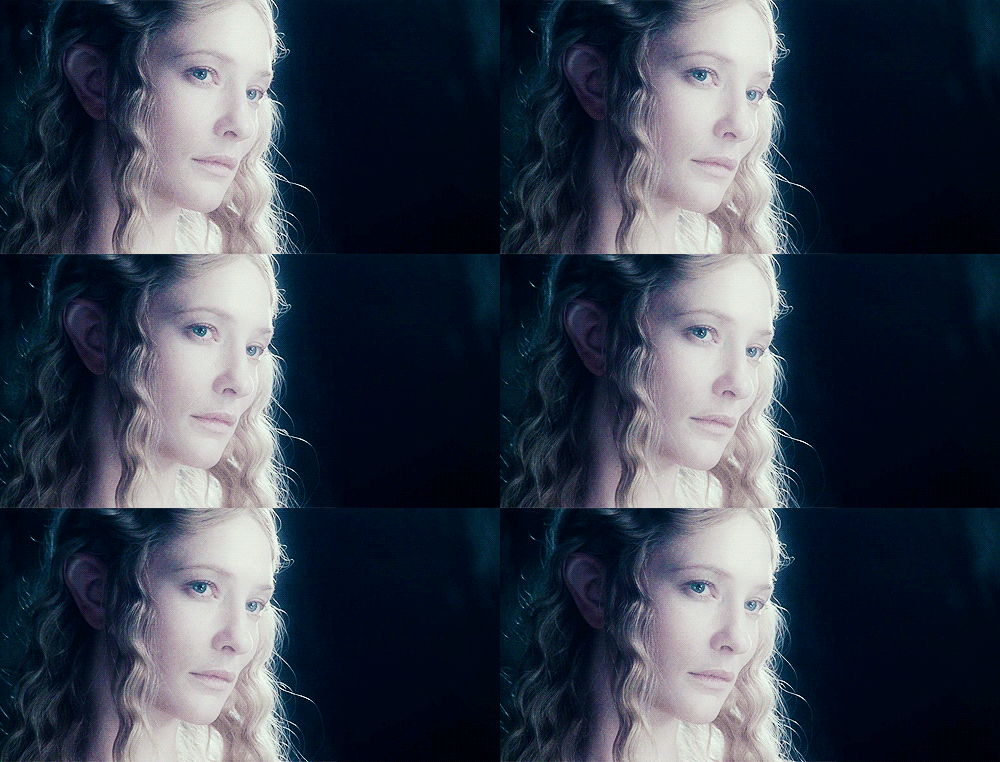
This week we discuss Galadriel, Cate Blanchett’s most iconic role. We delve into the enduring populariy of The Lord of the Rings trilogy and what diffrentiates them as excellent action adventure films, what makes Galadriel so special within Blanchett’s filmography and even ask Peter Jackson for a Boromir / Aragon rom-com. For this conversation Murtada Elfadl welcomes filmmaker Conrado Falco, co-creator of the show Wormholes and host of The Criterion Project podcast.

Click to listen:

Subscribe:  Apple Podcasts   /   Stitcher   /  Spotify  /   iHeart

Follow along the trilogy is streamig on HBO Max.

What is the film about?

 Based on J R R Tolkien’s trilogy about hobbits, elves and that one ring. In this episode we maninly discuss the first film; The Fellowship of the Ring.

From imdb: “A meek Hobbit from the Shire and eight companions set out on a journey to destroy the powerful One Ring and save Middle-earth from the Dark Lord Sauron.

Who does Cate play?

Galadriel, queen of the Elves with her pointed ears.

How is Cate introduced?

Almost immediately in voice over narrating the prologue that explains the creation of the One Ring. Her voice starts it all. Then she appears in all her blond ethereal beauty.

What year did it come out?

2001 the sequels in 2002 and 2003. The Hobbit movies came out in 2012, 2013 and 2014.

Box Office: Domestic = $315 MM Int’l = $888MM

Critical Response: Metacritic : 92 RT: 91

Topics Discussed:

  • Why were these films so popular?
  • Why Galadriel became one of Blanchett’s most iconic roles. The look, the character and her performance.
  • Well made adventure film especially when compared with mediocre output of current superhero movies. Grand old fashioned entertainment. Why does the adventure and the scale work well?
  • Earnestness done well. How these films wonderfully portray friendship.
  • Ian McKellen’s wonderful and equally iconic performance as Gandalf. How/ why he lost the Oscar?
  • Homoeroticism between Aragon and Boromir. Their relationship has the beats of a rom-com.
  • The many endings of The Return of the King. Despite their abundance they are a nice hang, as if visiting old friends one last time.
  • The metaphor of the ring – what does it mean or stand for? It could mean differnt things depending on interpretation.
  • Cate’s friendship with Ian Mckellen.
  • Deep dive into the “all shall love me and despair‘ scene.
  • Frodo as the ultimate “damsel in distress.”
Cate Blanchett as Galadriel and Ian McKellen as Gandalf

Film within context of Cate’s career:

Her biggest hit and impact on popular culture. Many remember her as Galdriel. Playing this ethereal icon fed into her own iconic status as a movie star. 

Subscribe:  Apple Podcasts   /   Stitcher   /  Spotify  /   iHeart

Like? Rate and Review. Have a question? Leave us a comment.

Kate Winslet in ‘Ammonite’

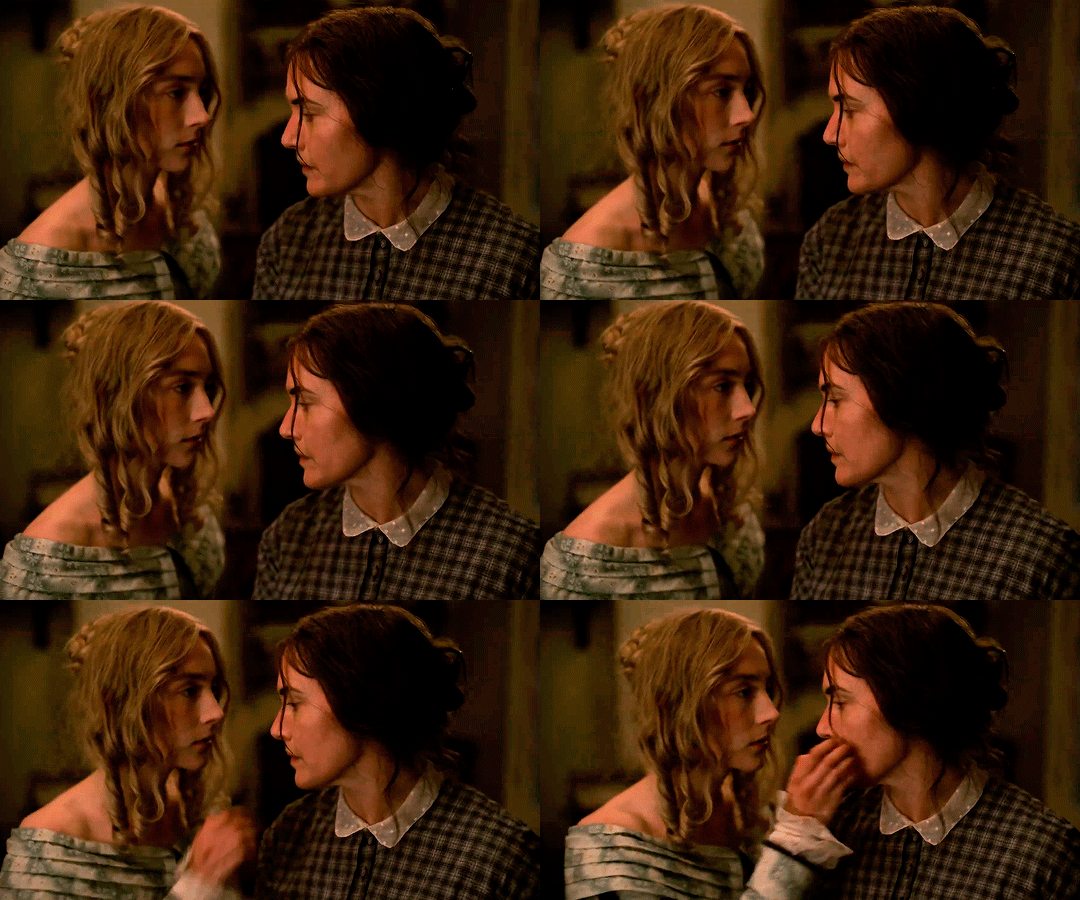
This week we take a brief detour from the films of Cate Blanchett. Instead we are discussing a current film, out on release now, Ammonite. Plus the career of Kate Winslet  and in the latter part of the podcast we discuss a few other queer films out this season. Hosted by Murtada Elfadl with guest queer writer-performer, producer and filmmaker Ren Jender, whose work has appeared in The New York Times, NPR, Slate, Bandcamp and The Village Voice.

Click to listen:

Subscribe:  Apple Podcasts   /   Stitcher   /  Spotify  /   iHeart

What is the film about?

From Wikipedia: “Acclaimed paleontologist Mary Anning works alone selling common fossils to tourists to support her ailing mother, but a chance job offer changes her life when a visitor hires her to care for his wife.”

Who are the main characters?

Mary Anning (Kate Winslet) – a real life fossil hunter who is known to have been single, no historic evidence of her being queer which raised mild controversy before the film’s release – though that’s par for course since queer history is never recorded

Charlotte Murchison (Saoirse Ronan) – also a real life person though reportedly older that Mary in real life, there is evidence that Mary was invited to her London house for a weekend.

Elizabeth Philpot (Fiona Shaw) – Mary’s neighbor and assumed former lover.

Molly Anning (Gemma Jones) – Mary’s mother and live-in companion.

Roderick Murchison (James McArdle)- Charlotte’s clueless husband.

Topics discussed:

  • Why this story now? A continuation of presenting queer woman in mostly historical stories.
  • The chemistry between Winslet and Ronan.
  • The initial marketing made the sex scene the focus – wise decision?
  • Might the film have been more interesting if it was about Mary Anning’s life and work and not this concotted love story.
  • Fiona Shaw’s performance.
  • Comparison to Francis Lee’s previous queer film, God’s Own Country, another queer romance with roots in the lead’s work and their connection to the earth.
  • Austere filmmaking, minimal dialogue, drab costumes and settings -did these choices work?
  • Is the film boring as this humorous article claims?
  • Comparison to Portrait of a Lady on Fire and Rafiki, two other recent films about queer women. Read Ren’s article on both films, and Murtada’s interview with Wanuri Kahiu, the director of Rafiki.
  • Highlights of Winslet’s career: Sense and Sensibility, Jude, Peter Jackson‘s Heavenly Creatures. Her long association with the Oscars, awards narrative and post The Reader shunning.
  • Other queer movies from this season: I Carry You With Me, No Ordinary Man.

Subscribe:  Apple Podcasts   /   Stitcher   /  Spotify  /   iHeart

Like? Rate and Review. Have a question? Leave us a comment.

Frances McDormand in Nomadland

I recently saw Nomadand at the New Yorl Film Festival from the comfort of my couch.

“You know you are not watching just any old prestige drama when a film throws in a shot of its lead character – played by a 2-time Oscar winner – defecating a mere three minutes into its running time. Chloé Zhao’s Nomadland is a film concerned with the concrete realities of life. Things that might seem mundane or unmentionable but take up a big part of everyday life. How a woman carves a small place on earth to sleep, eat, work and yes defecate.”

Read the rest of my review at The Film Experience.

Like? Rate and Review. Have a question? Leave us a comment.

Fashion Moments We Hope to See at Venice

Cate Blanchett will start her jury president duties at the Venice International Film Festival this Wednesday September 2. The festival will be the first major international film event since the Covid-19 pandemic cancelled all events around the world. Fashion lovers  are cautiously excited since there will be some sort of red carpet.

Blanchett has indicated in an interview with WWD magazine that she plans to exclusively re-wear looks from her closet throughout the festival. Yes, no new couture for Cate this year. It fits a socially distant event to be more responsible and promote sustainability. So we applaud the decision and suggest six looks we hope to see on Cate in the next 10 days.

Arriving at this list was arbitrary. Balnchett has wowed so many times that it’s futile to try to come with any rhyme or reason for my choices. It’s just a few that I love. There is one I did not choose whilst being my favorite because I’d like it to remain exclusive to that moment, the Carol premiere at Cannes. 

Where / When : The Oscars, February 2011

Designer: Givenchy 

Divisive at the time but now universally acknowledged as one of Cate’s most audacious red carpet moments. Everything about it is unusual. The pale lavender color spiked with yellow, the intricate embroidery, the pleats and the architectural breast piece. So avant garde, so Cate!

Where / When: SK-II event in Shanghai, September 2010

Designer: Christian Lacroix 

This is more obscure yet remains one of my faves ever. A glowing burgundy gown embellished with shimmering gold sequins. We have previously waxed poetic about it on the pod.

Where / When: The Oscars, February 2007

Designer: Armani

She wore this column Armani couture silver sheath the year she was nominated for Notes on Scandal. That was also the year she witnessed a moment we love from the telecast. You can see her front row clapping and whooping when The Aviator director, Martin Scorsese won his first Oscar after many nominations and decades of a wonderful career. 

Where / When: Cannes Opening Night and premiere of Robin Hood, May 2011

Designer: Alexander McQueen 

What a way to pay tribute to the recently deceased McQueen at the time. Cate wore this gorgeous black and white gown with the striking eagle print just 3 months after McQueen had passed.

Where / When: The Good German, LA premiere, December 2006

Designer: Versace 

This cream and gold peekaboo dress is singular but rarely mentioned in any fashion retrospectives about Cate. Bring it back, let the people enjoy.

Where / When : The Oscars, February 2005

Designer : Valentino 

Go big and re-wear something from one of your biggest career moments. That would be the bespoke Valentino that was specially designed for her to collect her first Academy Award. Cate and Valentino wanted to create a unique fashion moment, so he dressed no one else that year at the Oscars. This Yellow taffeta with the mauve sash was certainly a big wow and my favorite Oscar fashion from Cate. 

I haven’t chosen anything from last year’s Venice or from her stint as jury president in Cannes 2018 because I wanted to go further back in time. However let us know in the comments what you want to see repeated from those festivals?

Subscribe:  Apple Podcasts   /   Stitcher   /  Spotify  /  Pandora /   iHeart

Like? Rate and Review. Have a question? Leave us a comment.