Cate Blanchett is back in cinemas this holiday season. And the podcast is back for a final season of episodes. We kick things off with the first of the two Cate movies coming out this month, Guillermo del Toro’s Nightmare Alley. For this conversation Murtada welcomes film critic Leila Latif, to discuss the film, how it differs from 1947 version, and the performances of Cate as a femme fatale, Rooney Mara, Bradley Cooper and Toni Colette.
From IMDB: An ambitious carny with a talent for manipulating people with a few well-chosen words hooks up with a female psychiatrist who is even more dangerous than he is.
Directed by Guillermo del Toro, with a screenplay by Guillermo del Toro & Kim Morgan, adapted from William Lindsay Gresham’s novel.
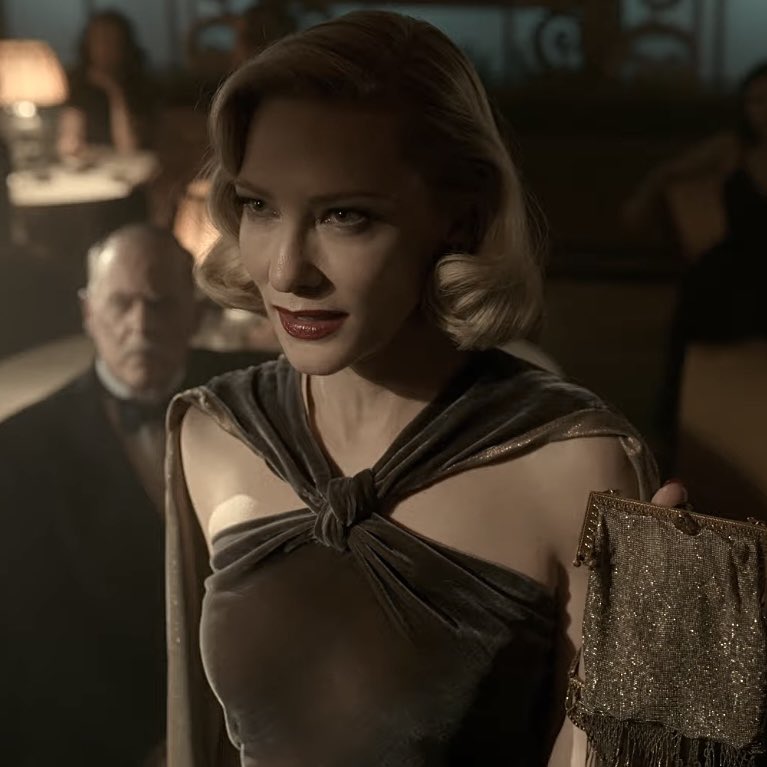
Who does Cate play?
Lilith Ritter, a psychologist with a dark past and hidden agenda, who holds the key to the events unraveling in the film.
How is Cate introduced?
About an hour into the 2 and half hour movie, in shadows in a nightclub. A real movie star introduction.
Topics discussed:
A bleak noir within Del Toro’s obsessions; only this time the monsters are human and there are no supernatural elements
The arc of Stan’s character as played by Bradley Cooper.
Cate as noir femme fatale – delivered on the promise of The Good German.
This is another of Blanchett’s oh so glamorous roles.
Because of the genre (noir) and period (1940s) Blanchett’s performance has been compared to the stars of Hollywood Golden Age. Does she remind us of any in particular?
The chemistry between Blanchett and Cooper.
The all star cast, who makes an impression? Rooney Mara, Toni Colette, Willem Dafoe, David Strathairn, Richard Jenkins, Mary Steenburgen…… etc.
The crafts – the production design (Lilith’s office, the carnival), costumes, lush cinematography (does it fit the genre?)
This version vs the 1947 version.
The 1st half vs the 2nd – there seems to be a clear divide and a clear favorite with those who watched so far
Does the film have full frontal nudity? It’s “blink and miss it,” but it’s there and in these cinema puritanical times I appreciated it.
We rank Nightmare Alley within Del Toro’s filmography and Cate’s.
*********SPOILERS********* Skip between 28.00 and 36.00 if you don’t want to be spoiled*********
The podcast returns on Sunday December 19th for a fourth and final season. Listen to this short announcement where the first film discussed is revealed.
Halfway through Spencer I began to question whether I have ever liked Pablo Larrain as a filmmaker. Earlier this year his adaptation of Stephen King’s Lisey’s Story was unwatchable. I did not care for The Club (2015). But I had to remind myself that I liked No (2012), Jackie (2016) and Neruda (2016). Maybe this new one will end up in the like column as well. Alas it did not.
Spencer is supposedly the story of the weekend country sojourn in which Princess Diana of Wales, née Spencer (Kristen Stewart), decided to divorce Prince Charles (Jack Farthing). It’s told like a ghost story; a woman in peril in a big house, surrounded by dubious people, some might be in her corner, others want to sabotage her. It’s Diana as Rebecca(1940). And it’s as alienating as much of Larrain’s work. Though done with top notch craft and an aesthetic recognizable to most cinephiles.
Larrain and screenwriter Steven Knight have a good premise. They are trying to tell a story of finding the fortitude to break away from a life that’s suffocating while being completely isolated. However they run out of narrative threads quickly and spend the rest of the movie repeating themselves. Diana, isolated with no one to trust. The servants in the big house (Timothy Spall, Sean Harris and Sally Hawkins among them) might be spying on her for the royal family. Or are they her allies? Repeat over and over again. Then so many scenes of Diana running. Along hallways, in the meadows. And so much twirling. So much twirling. So much of it that it bears repeating. The movie’s true title should’ve been “Twirling With No Substance.” Who knew it would be Larrain who would inherit the mantle from Terence Malick in this most dubious of categories.
There is nothing about what Knight wrote or what Stewart plays that is specifically about Diana. The details are vague. This could be about any anonymous rich white lady trapped in a cult. One who has access to fancy clothes, castles, maids and personal cooks. Stewart plays her like a haunted woman trapped and she’s effective. However she neither looks nor sounds like Diana. Inhabitation is not necessary with biopics, sometimes just a nod to the real person is enough. See Renee Zellweger as Judy Garland. But there’s not even a nod here. If this wasn’t called ‘Spencer” we wouldn’t be talking about awards. Nor would a swath of the potential audience be interested. So maybe it’s a calculated move. Let’s make a movie about a haunted woman trying to escape from a cult. Any woman, no need to be specific nor add any recognizable details. But still call it Spencer. Boo! Awards. Buzz. Magazine covers. Box office though might not materialize if enough people catch on to what it really is.
Impersonation aside, Stewart is no more than fine. She plays this woman as very frightened, as if she’s in a gothic horror film. Whispery breathy voice, quizzical look. It fits the framework Larrain put her in. However the critical response to this performance is baffling. Even within Stewart’s limited oeuvre it doesn’t stand out. She’s been much more affecting with Olivier Assayas in Clouds of Sils Maria (2015) and Personal Shopper (2017).
All of this would have been forgotten if Spencer actually had a story to tell. This is a bunch of scenes shot well, with actors repeating the same notes over and over in different but limited locations. There is nothing to see here.
About the hundredth time characters in Mike Mills’ C’mon C’mon expressed themselves clearly and verbosely and said exactly how they were feeling at that moment, I almost lost it. Who has this clarity? Who can articulate their feelings so eloquently at every waking moment of their lives? Who are these people? They must be aliens from an alternate universe of never ending therapy sessions. These people have done the work and figured themselves out. Even the 10 year old kid. Movies are not real, I understand that. Yet this is one that wants to be taken as reality, while not realizing what a fantastical world it has built. And a false one at that.
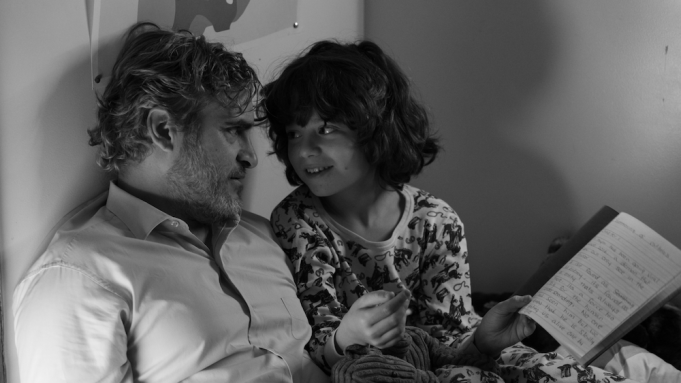
The film stars Joaquin Phoenix as Johnny, a radio talk show host who’s making a documentary about what children think of the future. He’s going around the country interviewing young people when his sister Viv (Gaby Hoffman), asks him to take care of her child, Jesse (Woody Norman). She has to leave town to deal with the child’s father (Scoot McNairy), who’s in the grips of a manic episode. Obviously uncle and nephew will make a deep connection. Though tentatively at first, perhaps running into some misunderstandings. Yelling, tears and laughter will be involved. And if you guessed Jesse will be interviewed for his uncle’s program and make a profound statement, then you’ve hit the jackpot.
Yet none of the events that happen on screen feel real. Interspersed through the main narrative are the interviews Johnny conducts with kids in LA, New York and New Orleans. I guessed we were supposed to feel the anxiety of the next generation and their hopes. I said I guessed because what was on screen was merely false platitudes that rang hollow. The exception is one young person speaking about losing faith in the adults who are supposed to help but can’t.
In flashback we see Johnny and Viv taking care of their late ailing mother. Again we are supposed to understand the enormous grief and the years of pent up frustration between the siblings. But because they keep telling us in the present how they were feeling at the time, it doesn’t make the impact Mills hopes for. The last straw for me was using the oldest trick in the book; the precocious child who asks the “difficult” questions. Boy did I roll my eyes. Cheap and teetering on insufferable.
The black and white cinematography gives the audience something nice to look at while watching what’s inherently not a cinematic story. It’s mostly people on the phone talking about their feelings. The cast acquits themselves well, especially when you consider they are tasked with being in constant open wound mode. This a more relaxed Phoenix, reminiscent of his work in Her (2013) and miles away from Joker (2019). Hoffman has to play 90% of her scenes talking into an iphone, maybe Mills is trying to make a point about how we communicate today or something. Wish he could’ve varied the technology so we could see Hoffman in more than just the one mode. Though all the actors try their hardest to bring empathy to their characters; something was missing. Like what Annette Bening was able to do in Mills’ previous film 20th Century Women (2016); add a dose of no nonsense to the saccharine proceedings.
C’mon C’mon played the Spotlight section at the 59th NewYork Film Festival and will be released on November 19th.
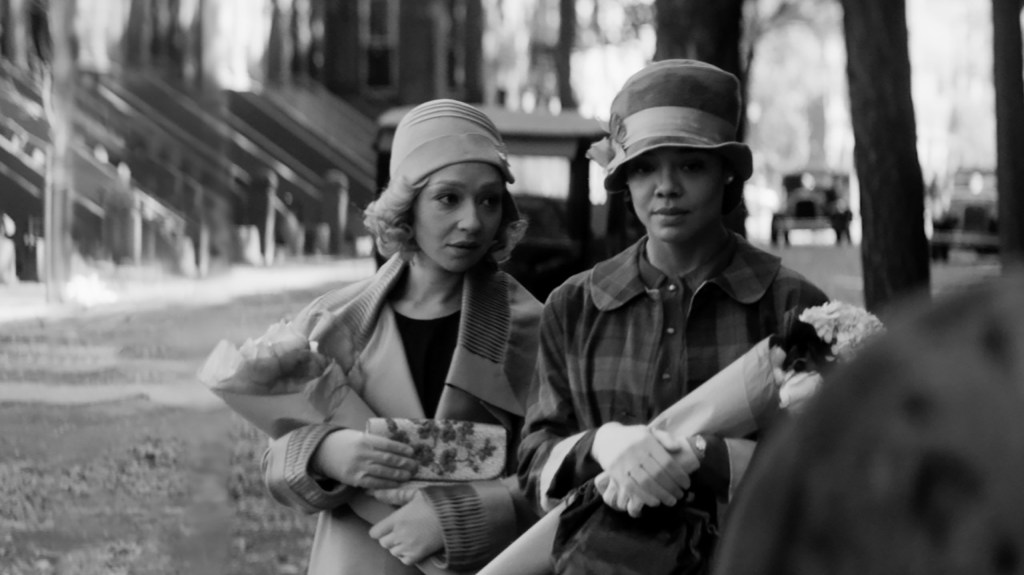
Ruth Negga and Tessa Thompson in Passing by Rebecca Hall.
A few minutes into Passing, Ruth Negga appears. She’s Clare Kendry, who is in New York accompanying her husband (Alexander Skaarsgaard) on a business trip when she spots an old friend Irene Redfield (Tessa Thompson) in the lobby of the Drayton Hotel. Resplendent in 1920s garments, blond hair and a mischievous smile on her face, Negga’s the cat that ate the canary personified on screen. Over the next few minutes she flirts with, cajoles and charms Irene into visiting her suite, staying and having drinks despite Irene being very uncomfortable. Irene can’t resist Clare and we in the audience cannot take our eyes off Negga for a second for fear of missing a gesture or a look. This is a performance so electrifying it demands attention from the very first second the character appears.
Passing, adapted from Nella Larsen’s novel and directed by Rebecca Hall, is the story of these two light skinned Black women living during the 1920s Harlem Renaissance. Irene occasionally passes for white for convenience. To take refuge in a cool hotel lobby during a heatwave. Clare passes for white all the time, she’s married to white man who doesn’t know she’s Black. When Clare moves to New York she decides to revive her friendship with Irene despite the latter’s discomfort with her lies and way of living. But close they become, as Clare longs to spend more time among Black people.
Larsen’s novel is rich with themes about identity and race. About the masks people put on and take off to survive. The relationship between Irene and Clare is complex. Do they like each other? Are they jealous of each other? Does Irene want Clare’s daring and carefree attitude? Clare seems to covet Irene’s sense of purpose and satisfaction with her lot in life. Hall threads the very fine line of including as much as she can from the source while not overwhelming the film. More often than not, she holds back rather than spell out anything. Her script is so subtle demanding the audience pay attention. Not to the words the characters are saying but rather to the performances the actors are giving.
And in Thompson, and particularly Negga, Hall hits pay dirt. Thompson holds the film together with grounded feeling as she’s in every scene. Irene is a woman who doesn’t say much, who holds her cards close to her chest. Thompson manages to convey her inner turmoil with understated panache. Negga comes in with reckless abandon and steals the film. This is a showstopping performance. She conveys the utter chaos of the character while maintaining the actor’s exacting control. Negga drops her voice when needed to amplify a point. She looks straight into the camera to throw off the audience from the conclusions we thought we made about the narrative and her character.
Everytime Negga looked at Thompson I thought to myself, “does she want to fuck her or kill her?” That sexual subtext was in the book but it’s more overt in the movie because of the performances. These women are clearly drawn to each other. They might want to trade places. The way they look at each and sometimes touch, they definitely feel a sexual charge. What I wish the movie had more of is the feel for Harlem in the 1920s. This is more a chamber piece set in a few rooms and hallways, concentrating on a few characters.
I am also conflicted about the use of black and white. On one hand making a film about colorism and draining it of color seems strange. Yet the film looks gorgeous and the actresses would not have “passed” to modern eyes if not for the black and white cinematography. Aesthetically it’s definitely the right choice as it fits with the other austere and deliberate choices Hall makes. From her sparse script to the intimate atmosphere that’s all inside Irene’s mind.
Passing is a confident, sometimes bold, directorial debut for Hall. It is also Ruth Negga’s most magnetic moment on screen. And for that it’s well worth cherishing.
Glamour! Big Acting ! An Accent! A few hallmarks of Cate Blanchett’s performances that we love are present in Sally Potter’s The Man Who Cried (2001). It’s a commanding star turn that shows Blanchett at her best, and for that the movie is a must-see for every Blanchett fan. We discuss the film and performance. Plus revisit Mrs. America and the show’s chances at the winter TV awards (Golden Globes and SAG).
From Wikipedia: A Russian Jewish girl (Christina Ricci) is separated from her father in 1927 and escapes to England, where she’s rechristened Suzie. She grows up to be a singer in a Parisian theater populated by a glamorous Russian dancer (Cate Blanchett), an egotistical Italian tenor (John Turturro) and a handsome horseman (Johnny Depp). When the Nazis invade France, however, Suzie’s life is suddenly in danger, and she attempts to flee to the United States, where her father moved years earlier.
Who does Cate play?
Lola, a glamorous Russian dancer.
How is Cate introduced?
20 minutes in as the star attraction amidst a chorus of dancers. after she finishes the dance, she winks directly at the camera and the audience.
What year did it come out?
Premiered at Venice September 2000. US release May 2001.
This movie hardly made a ripple in 2001. It is one of the very few Cate performances that I have never watched until now. Very hard to find…. youtube is your friend (wink).
Sally Potter as a distinctly visual filmmaker.
One of Cate’s early roles. Does the star quality appear? Of course, in fact this is a must-see for any Cate Blanchett fan because it shows her total command and allure as a screen star.
NBR awarded Cate best supporting actress for 2001 body of work including this, LOTRand The Shipping News.
Again a very physical full bodied performance – a theme we’ve talked about on this podcast. There’s a nervous energy to it though. Lola is always moving, gawky, not graceful like some of her other characterizations.
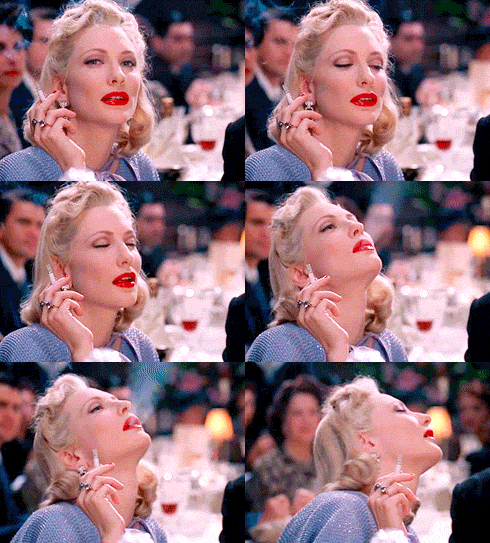
Memorable look; albaster skin, red cherry lipstick, very blond hair – so very noticeable
Cate the droll comedian, we dig deep into one scene; when telling the rules of seducing men… “without my looks I wouldn’t have gotten out of Russia.”
Lola is a tragic figure . We talk about how Cate makes her so with emphasis on a couple of other scenes.
One of a few movies that Christina Ricci headlined – what do we think of her?
What’s with all the brooding Johnny Depp on horseback scenes – for a while both he and Ricci are silent in their scenes together.
Film within context of Cate’s career:
2000 – 2001 was the time when the choices she made post her breakout with Elizabeth began appearing for audiences. She chose a few supporting roles; all of them very far from that monarch and one lead role in The Gift (2000); previously discussed.
What reviews said of film / Cate:
“Blanchett’s role is the dazzler: Rolling her eyes, shrugging her shoulders and flinging her long limbs about insouciantly, she’s the soul of studiously artificial glamour, whether shimmying in a trashy revue or bewitching an unwary suitor.” – Maitland McDonagh, TV Guide.
“The movie is like a series of climactic moments from a World War II mini-series strung together without the undercurrents that might build character: it’s all big moments, the world’s longest and most sincere trailer. In fact, the title character doesn’t even appear until the end of the picture. (Before that the film should be called ”The Woman Who Cries,” since Ms. Ricci’s trembling chin gets quite a workout.)
With accents heavier than the melodrama going on around them, Ms. Blanchett and Mr. Turturro add comic weight and warmth as two predators sizing each other up before they realize they’re the same species.” – A O Scott, NYTimes.
“Ironically, in the midst of all this high caloric camp, the one performer who escapes with her dignity, Cate Blanchett, does so not by underacting but by getting in full shameless touch with her miscast inner ham. As Lola, a transplanted Moscow gold-digger with a borscht thick accent and lips as glossy red as the inside of a chocolate covered cherry, Blanchett is like Mata Hari played by Gwen Stefani impersonating Veronica Lake. It’s hard to take your eyes off of acting this knowingly overripe.” – Owen Gleiberman, EW
This week we discuss Galadriel, Cate Blanchett’s most iconic role. We delve into the enduring populariy of The Lord of the Rings trilogy and what diffrentiates them as excellent action adventure films, what makes Galadriel so special within Blanchett’s filmography and even ask Peter Jackson for a Boromir / Aragon rom-com. For this conversation Murtada Elfadl welcomes filmmaker Conrado Falco, co-creator of the show Wormholes and host of The Criterion Project podcast.
Based on J R R Tolkien’s trilogy about hobbits, elves and that one ring. In this episode we maninly discuss the first film; The Fellowship of the Ring.
From imdb: “A meek Hobbit from the Shire and eight companions set out on a journey to destroy the powerful One Ring and save Middle-earth from the Dark Lord Sauron.“
Who does Cate play?
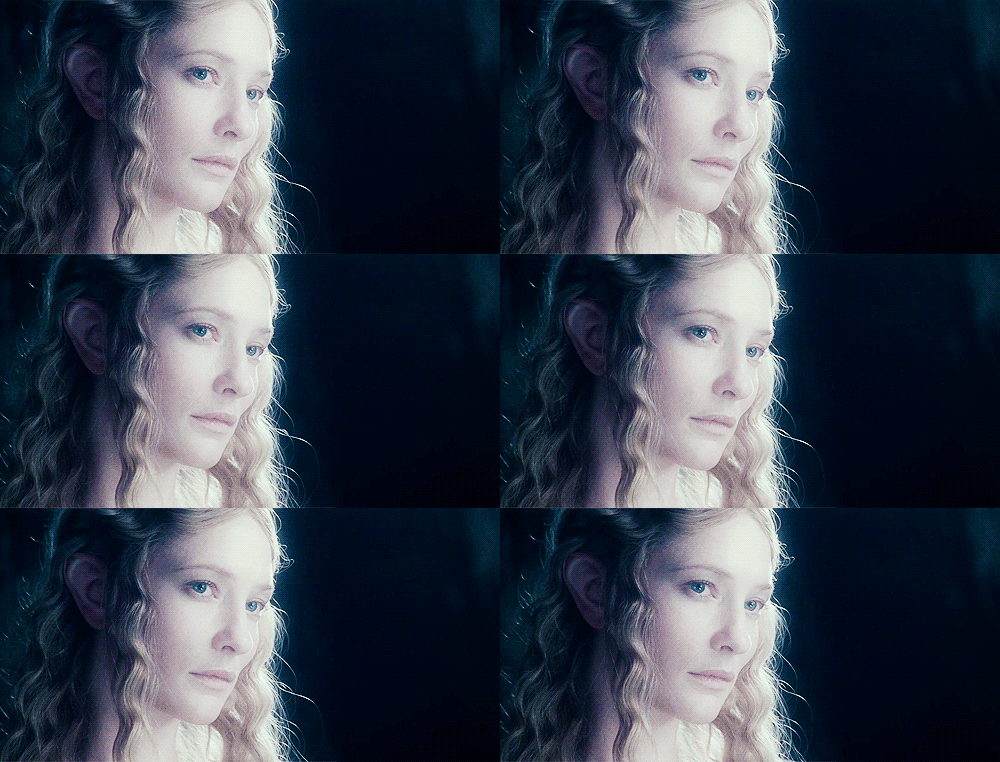
Galadriel, queen of the Elves with her pointed ears.
How is Cate introduced?
Almost immediately in voice over narrating the prologue that explains the creation of the One Ring. Her voice starts it all. Then she appears in all her blond ethereal beauty.
What year did it come out?
2001 the sequels in 2002 and 2003. The Hobbit movies came out in 2012, 2013 and 2014.
Why Galadriel became one of Blanchett’s most iconic roles. The look, the character and her performance.
Well made adventure film especially when compared with mediocre output of current superhero movies. Grand old fashioned entertainment. Why does the adventure and the scale work well?
Earnestness done well. How these films wonderfully portray friendship.
Ian McKellen’s wonderful and equally iconic performance as Gandalf. How/ why he lost the Oscar?
Homoeroticism between Aragon and Boromir. Their relationship has the beats of a rom-com.
The many endings of The Return of the King. Despite their abundance they are a nice hang, as if visiting old friends one last time.
The metaphor of the ring – what does it mean or stand for? It could mean differnt things depending on interpretation.
Cate’s friendship with Ian Mckellen.
Deep dive into the “all shall love me and despair‘ scene.
Frodo as the ultimate “damsel in distress.”
Cate Blanchett as Galadriel and Ian McKellen as Gandalf
Film within context of Cate’s career:
Her biggest hit and impact on popular culture. Many remember her as Galdriel. Playing this ethereal icon fed into her own iconic status as a movie star.
It’s time for another delicious villian from Cate Blanchett. The Wicked Stepmother in ‘Cinderella,’ the 2015 live action Disney remake, directed by Kenneth Branagh. For this conversation Murtada Elfadl welcomes writer and podcaster Manish Mathur, host of It Pod To You and Queer and Now podcasts.
From Wikipedia: After her father unexpectedly dies, young Ella (Lily James) finds herself at the mercy of her cruel stepmother (Cate Blanchett) and stepsisters, who reduce her to scullery maid. Despite her circumstances, she refuses to despair. An invitation to a palace ball gives Ella hope that she might reunite with the dashing stranger (Richard Madden) she met in the woods, but her stepmother prevents her from going. Help arrives in the form of a kindly beggar woman who has a magic touch for ordinary things.
Who does Cate play?
The Wicked Stepmother, Lady Tremaine.
How is Cate introduced?
9 minutes in – Lucifer the cat on a leach, “how charming how perfectly charming.”
What year did it come out?
2015 / it was her follow up to Blue Jasmine. Premiered at the berlin film festival
Cate gives psychological depth to a usually cartoonish villain – but also hits the high comic notes.
Cate talked of being having thought of Joan Crawford and that’s certainly apparent in the hair / costumes and performance
“Have courage and be kind.” It’s hard to play good and kind, but Lily James manages it “they treat me as well as they are able.”
The script is fun in dramatizing the story beats we all know, e.g. Cinders being banished to the attic comes as a sweet suggestion to give her bigger room to the step sisters. Or how she meets the prince.
The film has a romantic sweep and the visuals look.
Manish’s favorite Cate co-star is Sarah Paulson IRL. Fun conversation about their freindship.
The Berlinale premiere and this cute moment:
Cate Blanchett fixing Lily James’ dress at the Cinderella premiere at the Berlinale in February 2015
What reviews said of film / Cate:
“As so often with Disney films, this one is owned by its villain. Cate Blanchett, jaw-dropping in an Easter Parade’s worth of amazing costumes (that 2016 Oscar should just be wrapped up and mailed to Sandy Powell now), is the ace up the film’s fitted satin sleeve. Striking catlike poses and oozing poison when required, she is also given a little humanity, including a surprisingly dorky, vulgar laugh that suggests just how studied and artificial her elegance is. One scene in which she tells her life story like she’s the heroine of a “once upon a time” tale, does in two minutes what “Maleficent” couldn’t do in two hours: it helps us understand her character’s brokenness without declawing her one bit.” – Jessica Kiang, The Playlist.
“Enter Cate Blanchett in a delirious swirl of candy-colored evil. As Ella’s wicked stepmother, Blanchett is nasty perfection from her blood red lips to her baroque Sandy Powell-designed gowns. She’s like a cross between Coco Chanel and Norma Desmond, and she smartly plays her harpiedom to the back row of the theater. The fizzy cocktail combination of Blanchett’s cartoonish hauteur and Branagh’s visual razzle-dazzle and confectionary sets (courtesy of the legendary Dante Ferretti) manages to take a tale as wheezy as Cinderella and make it feel almost magical again.”– Chris Nashawaty, EW.
This week we take a brief detour from the films of Cate Blanchett. Instead we are discussing a current film, out on release now, Ammonite. Plus the career of Kate Winslet and in the latter part of the podcast we discuss a few other queer films out this season. Hosted by Murtada Elfadl with guest queer writer-performer, producer and filmmaker Ren Jender, whose work has appeared in The New York Times,NPR, Slate, Bandcamp and The Village Voice.
From Wikipedia: “Acclaimed paleontologist Mary Anning works alone selling common fossils to tourists to support her ailing mother, but a chance job offer changes her life when a visitor hires her to care for his wife.”
Who are the main characters?
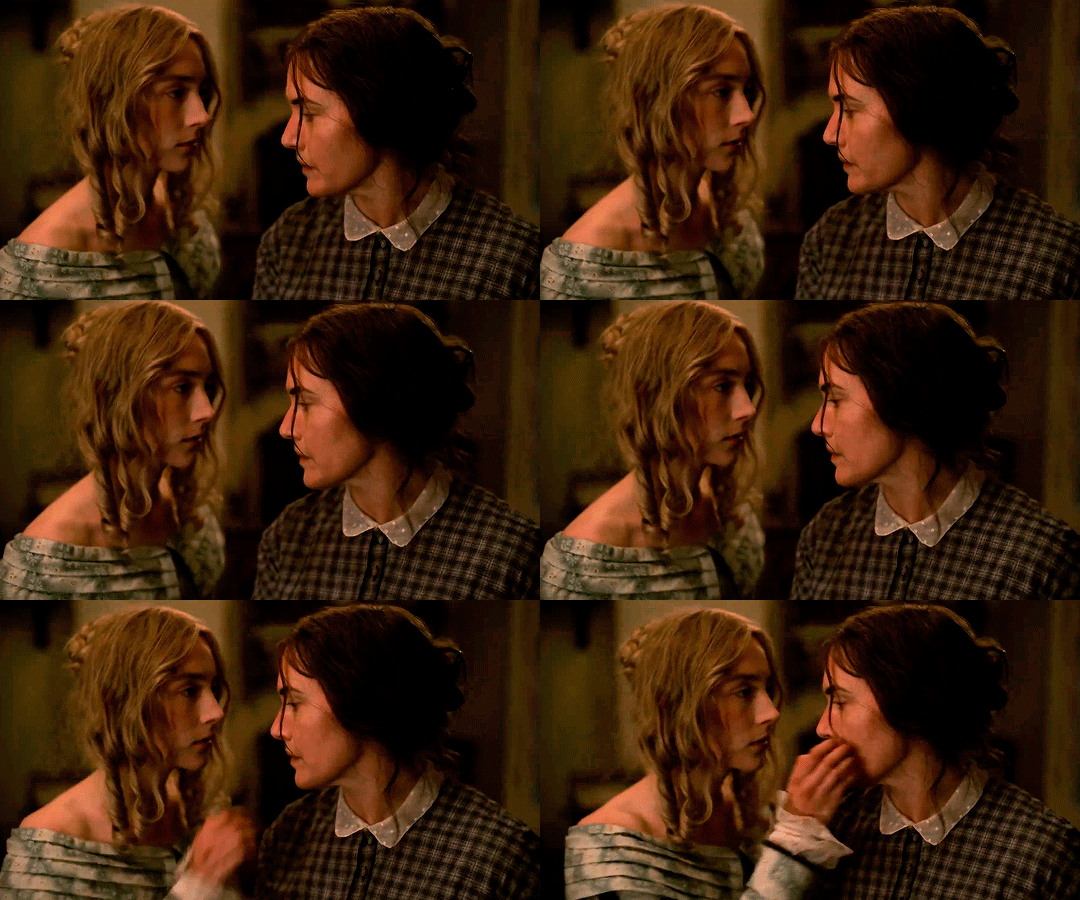
Mary Anning (Kate Winslet) – a real life fossil hunter who is known to have been single, no historic evidence of her being queer which raised mild controversy before the film’s release – though that’s par for course since queer history is never recorded
Charlotte Murchison (Saoirse Ronan) – also a real life person though reportedly older that Mary in real life, there is evidence that Mary was invited to her London house for a weekend.
Elizabeth Philpot (Fiona Shaw) – Mary’s neighbor and assumed former lover.
Molly Anning (Gemma Jones) – Mary’s mother and live-in companion.
Might the film have been more interesting if it was about Mary Anning’s life and work and not this concotted love story.
Fiona Shaw’s performance.
Comparison to Francis Lee’s previous queer film, God’s Own Country, another queer romance with roots in the lead’s work and their connection to the earth.
Austere filmmaking, minimal dialogue, drab costumes and settings -did these choices work?
Highlights of Winslet’s career: Sense and Sensibility, Jude, Peter Jackson‘s Heavenly Creatures. Her long association with the Oscars, awards narrative and post The Reader shunning.
Other queer movies from this season: I Carry You With Me, No Ordinary Man.
From imdb: Ruminations on the life of Bob Dylan, where six characters embody a different aspect of the musician’s life and work.
When did it come out?
November 2007.
Who does Cate play?
Jude Quinn; a riff on electric guitar 60s counter revolutionary Dylan.
How is Cate introduced?
A dead corpse in the opening of the film, then at min 46 as Jude Quinn with a long VO intro, comes out guitar in hand, then shoots the audience with machine guns.
Topics discussed:
Is this performance mimicry, a trick or much more? Did she find the soul behind the mannerisms?
Why was Cate singled out as the standout performance? Beyond genderbending what’s special about the performance?
Could we make the case for this being her best performance ever?
Which of the 6 Dylan personas work and which don’t? Why? Discussion the other performances.
Michelle Williams as Edgie Sedgwick and Julianne Moore as Joan Baez.
It’s an inventive way of making a biopic by having a take on its many different styles. Does it work?
D. A. Pennebaker’s 1967 documentary, “Don’t Look Back,” some of which Haynes remakes shot for shot.
Has the recent corporatization of music biopics – Bohemian Rhapsody, Rocketman, Yesterday – changed our perception of I’m Not There?
Famous quotes by the character:
Saying ’cause of peace’, it’s like saying, ‘hunk of butter’, you know, I don’t want you to listen to anybody who wants you to believe is dedicated to the hunk and not the butter
Scenes we liked:
Some images are breathtaking, especially the framing of Cate walking through a corridor.
Press conference, meeting Ginsberg, Cate’s final shot looking straight at the camera.
What seemed off:
What AO Scott called “occasional exasperation at Mr. Haynes sprawling, hectic virtuosity.”
Film within context of Cate’s career:
Released the same year as The Golden Age so she got a lot of notices about her range, “she can play both Elizabeth and Bob Dylan,” which added to her allure as the “best of her generation.”
Film within the context of year it’s been released:
Festivals: Venice, where Cate won the Volpi Cup as best actress.
Awards: Oscar nominee, Golden Globe winner (the year it was not televised), Indie Spirit winner, NSFC winner.
Reviews of film / Cate:
“The star of the show is undoubtedly Blanchett, who has great fun playing Dylan as a showboat who quite knowingly goes about creating his reputation for rebellious independence.” – The Hollywood Reporter.
“Stylistically audacious in the way it employs six different actors and assorted visual styles to depict various aspects of the troubadour’s life and career, the film nevertheless lacks a narrative and a center, much like the “ghost” at its core.” – Todd McCarthy, Variety.
“If the new film does cohere, for a while, that is thanks to Cate Blanchett, who, armed with curly wig and shades, delivers Jude Quinn, the most gripping of the Dylans on display. She looks like Elizabeth I after a long night out with Walter Raleigh and his packet of virgin smokes. Blanchett seems to yield herself to the project with more gusto and curiosity than the others, as if there were truths about Dylan that need to be unearthed, not merely toyed with, and she is unafraid to remind us of what a pain the man could be, especially when stoned, but even she has to wrestle with the camp knowingness of the script (“I’m the only one with any balls”) and, more alarming, with the flimsiness of the context.” – Anthony Lane, The New Yorker.
“Cate Blanchett, under Wayfarers and frizzy hair, does a spectacular, soul-on-the-sleeve enactment of Dylan in his Don’t Look Back media-put-on phase. Blanchett makes Dylan a cussed dude who uses his wit to wound, and Haynes’ slyest joke is that the actress, from her lurching marionette posture to her boyish cheekbones to her slurry misanthropic mumble, is the film’s most exquisitely spot-on Bob.” – Owen Gleiberman, EW.
“Mr. Haynes’s film hurls a Molotov cocktail through the facade of the Hollywood biopic factory, exploding the literal-minded, anti-intellectual assumptions that guide even the most admiring cinematic explorations of artists’ lives. Rather than turn out yet another dutiful, linear chronicle of childhood trauma and grown-up substance abuse, Mr. Haynes has produced a dizzying palimpsest of images and styles, in which his subject appears in the form of six different people.” – AO Scott, NY Times.
“Haynes is not what one would call a natural filmmaker. His ideas are too evident, his schemata overly present. He is, however, a sort of natural Brechtian: His actors are always “quoting.” I’m Not There gets surprisingly naturalistic performances from Ledger and especially Bale. But it’s the blatant alienation effect provided by Marcus Carl Franklin and Cate Blanchett’s fastidiously copied mannerisms that truly dramatize the self-invented, sheer sui generis–ness of the Dylan trip.”-J Hoberman, The Village Voice.
Cate in relation to these co-stars, director, costume designer:
Her first collaboration with Haynes. Later Carol. “We all owe a great debt of thanks To Todd Haynes’ body of work which has always been independent“ she said accepting the Indie Spirit award.
Press coverage other than reviews:
Todd Haynes to Rolling Stone on why he chose an actress for Jude:
“It was written and conceived as an actress to play the part of Jude from the beginning, before I knew it would be Cate. It was really just that moment in Dylan’s life. What was insane about the way Dylan looked in 1966 was that emaciated body, gigantic hair, the flying hands and the sort of weird marionette figure who was obviously exploring drugs and living on the edge. After the motorcycle crash, there was no flying hands, no big hair, no tiny, skinny body. That Dylan was gone forever. That’s such a famous image of Dylan. I wanted to try to reinfuse it with the cultural shock value of seeing that for the first time in 1965, ’66. So I thought an actress could be interesting, because there was an androgyny there. It wasn’t a Bowie androgyny, it was more a Patti Smith androgyny he was channeling.”
“She realised, she says, that Haynes wanted her to “inhabit the silhouette” of 1966 Dylan. “That’s why he’s cast a woman, because it’s the most iconic silhouette of his musical career. It was a really ironic gesture and also very clever. If a man played the role, people would have assessed it in a different way, whereas they’ve been able to get into the strangeness of what Dylan must have been like in that period by the very fact that I’m a woman. I don’t think it’s anything I’ve necessarily done.”
Blanchett with Haynes at the 2016 Oscars (this is also Chris’ favorite Cate red carpet moment)
Haynes on Cate and “the frame,” in an interview with The Film Stage:
“I have to say, the really extraordinary actors I’ve worked with really do care about the frame, when I was working with Cate Blanchett on I’m Not There, she was playing a man in this role of Jude. She would look at playback. She didn’t look out of a sense of vanity; she just wanted to see how her hips were being filmed and how to place her body in the frame to minimize the broadest curves of her female hips. Sometimes it’s very technical reasons why actors want to see what the frame is. It’s all relevant. It all plays into what is the language and the style, and how is that style informing the interpretation of the storytelling and character. I find some of these extraordinary people I’ve been lucky to work with ask questions about the frame, and it’s always for reasons of how they’re going to interpret their performance accordingly.”











 SUNDAYS WITH CATE